
First, it is helpful if you already know that ‘unlearning’ is one word
In today’s corporate world, environmental, social, and governance (ESG) factors play a major role in a company’s performance metrics, and diversity, equity, and inclusion (DEI) are major components of ESG. But what exactly are ESG and DEI and why should you care?
In its simplest form, it’s still all about the bottom line. It’s become very uncool for corporations to profit at the expense of the environment, employees and the communities they operate in while employing questionable business practices. Corporations that disregard environmental standards, treat employees, customers and communities like garbage, and do things considered unscrupulous, are no longer succeeding like they once were.
Further, several studies indicate that the business case for gender equality, diversity, and inclusion in the workplace continues to grow stronger. From improved financial and operational performance to enhanced employee engagement and retention, it’s clear that companies that invest in DEI initiatives in their workplaces outperform their peers.
As a former Corporate Moron© with over 25 years of office experience, I have participated in countless hours of leadership and corporate training endeavours.
When I embarked on my DEI learning journey, I was pumped. I thought, “I’m a woman, and this can only benefit me, right?” I already believe it’s a good thing to hire diverse individuals and create an inclusive corporate culture. I thought I was well-positioned to champion this work within my team and company.
I was ready to learn everything I already knew.
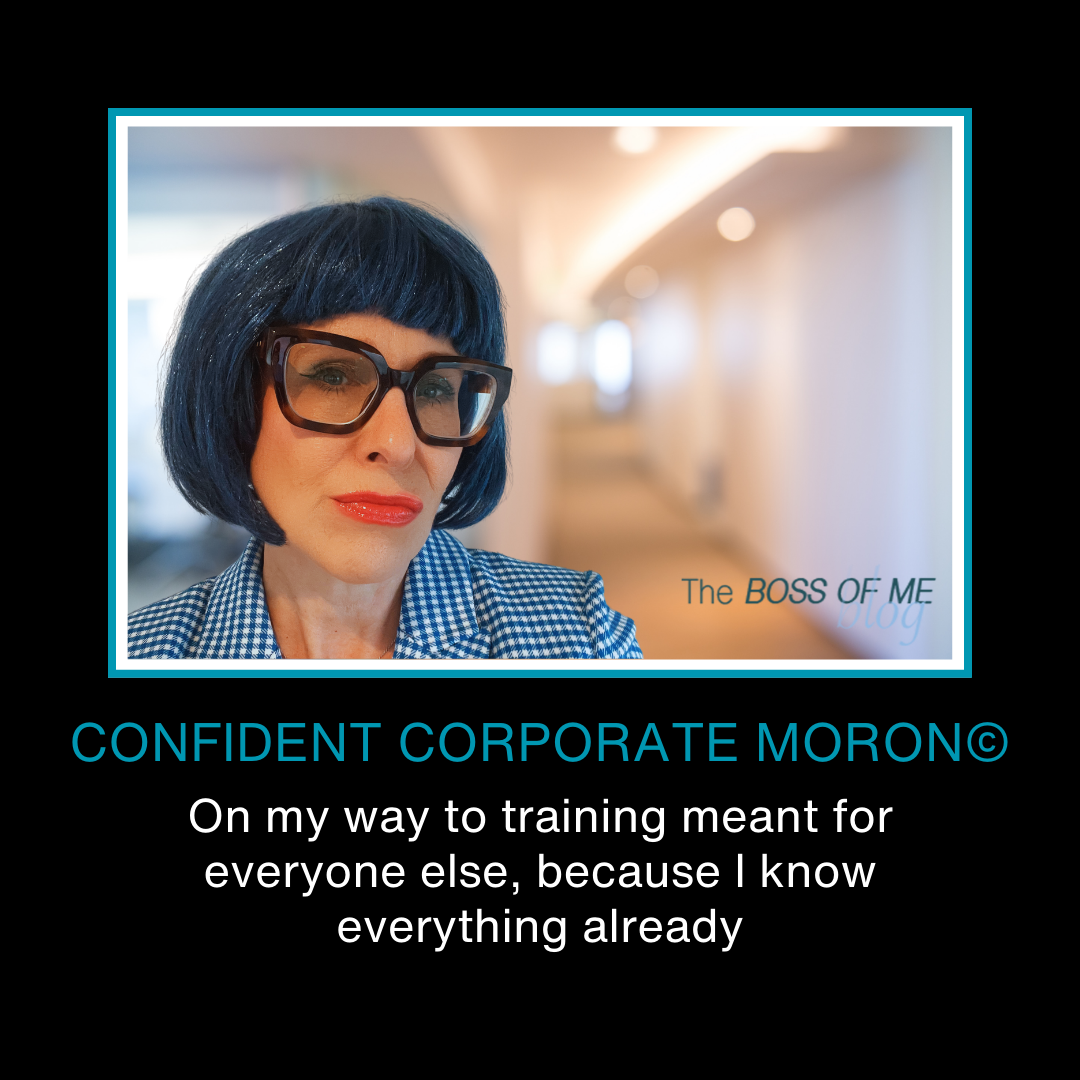
A Corporate Moron© who already knows everything goes on a DEI adventure
Full of confidence and prepared to multitask my way through the sessions, I was shocked and overwhelmed by all of the things I knew nothing about.
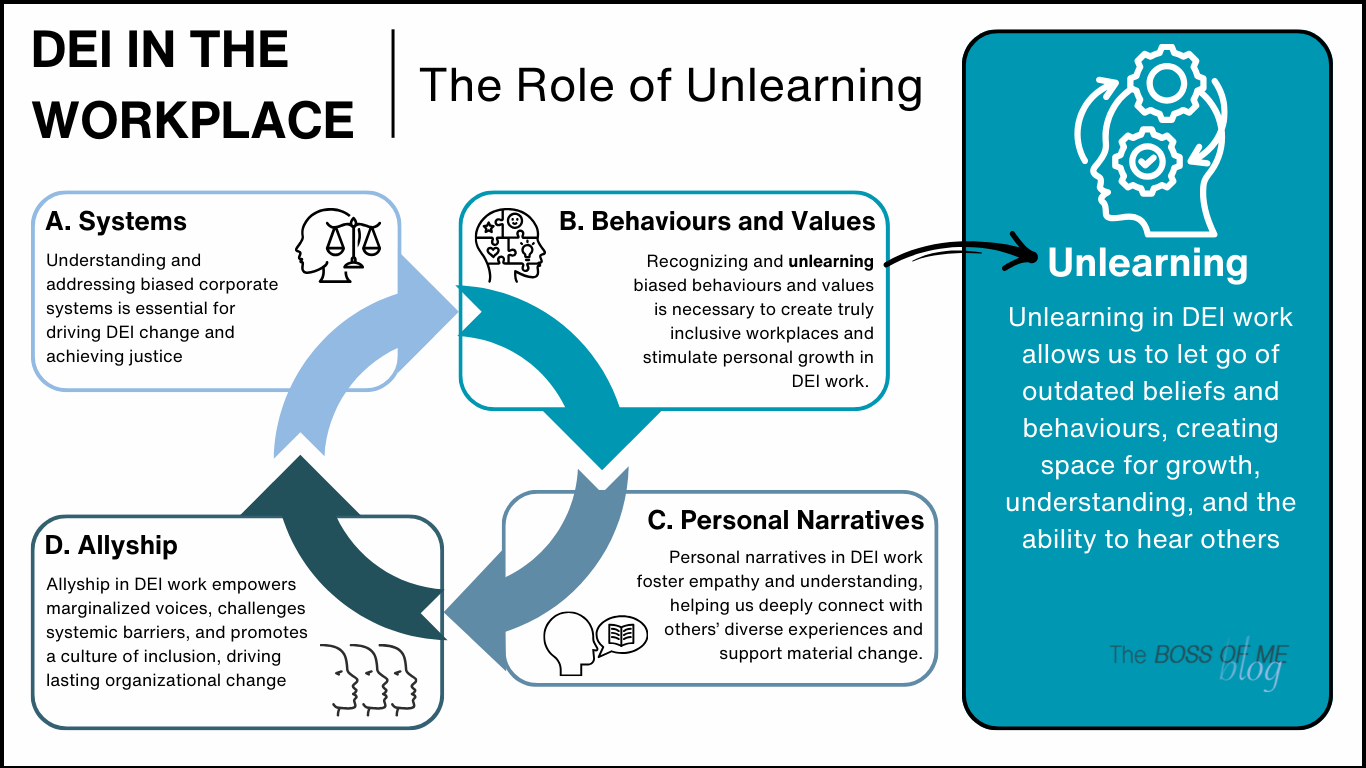
Systems: My DEI journey began with learning the distinctions between inequality, equity, equality, and justice, and recognizing how these concepts manifested in my daily work and organizational systems. After several PowerPoint presentations with pictures of trees and lengthy group discussions, I realized I hadn’t fully understood the systems I was operating within or how deeply they were connected to corporate culture. This realization became the foundation of my learning.
As with any meaningful organizational change, it’s essential to establish a baseline. Most corporate systems are biased, and acknowledging this is the first step toward change. I soon understood that achieving justice would require systemic transformation, which, while expected, is a complex and challenging process.
Understanding and addressing biased corporate systems is essential for driving DEI change and achieving justice.
Behaviours and Values: The next thing I learned about was microaggressions and biases. From microassaults, microinvalidations, and microinsults to all sorts of conscious and unconscious biases, the information on behaviours was overwhelming.
As I believe I am a good person, with a roster of a fairly diverse group of friends and colleagues, I was mortified. My initial instinct was to initiate a worldwide apology tour for all of the microaggressions I have inflicted upon others and for the just dumb, insensitive things I have said to pretty much everyone I know.
We all bring learned behaviours and past experiences into the workplace. And while most of us weren’t spewing hate and engaging in overt discrimination in our daily lives before now, we were far from behaving in ways that created and enabled the diverse, equitable and inclusive workplaces we all said we wanted. At least I was.
It was at this point I came to the mindblowing realization that not only did I not already know everything about DEI in the workplace, I had a lot to learn and more importantly, I had a lot to unlearn. Learning that all of what I knew was to now be challenged was eye-opening. After each session, we were asked to reflect on what surprised us about the content, and my recurring response was the importance of unlearning. How could I have so much to unlearn? I’m not a bad person.
Recognizing and unlearning biased behaviours and values is necessary to create truly inclusive workplaces and stimulate personal growth in DEI work.
Unlearning: As unlearning was a new concept for me I had to first learn what it was. Unlearning is letting go of how you currently do or think about something. My worldwide apology tour would have to wait. I needed to spend time unlearning to create space for what I needed to learn next. The good news is that our brains are always creating new pathways and were designed to both learn and unlearn. I knew I must have a few brain cells left that were up to the task, so I unleashed them on the task of unlearning.
This quote from Maya Angelou helped. A lot.
“Do the best you can until you know better. Then when you know better, do better.”
— Maya Angelou
Here’s what I learned about unlearning:
One final note on unlearning. This is not the time to hit up your social media channels to enlighten friends, family and strangers with your newfound knowledge. Bringing the message to folks who are not yet ready to hear it, and out of context, isn’t good. It creates more divisiveness. I know. We’re excited to share what we’ve unlearned, and the new world we’ve opened ourselves up to, but we need to take a beat and show others respect and compassion. They might not be ready yet.
Unlearning in DEI work allowed me to let go of outdated beliefs and behaviours, creating space for growth, understanding, and the ability to hear others.
Personal Narratives: While I am certainly tolerant and mostly accepting of others, I had very limited exposure to any real diverse experiences and perspectives. I’d never asked. I’m the one who’s busy talking all of the time. I realized I have my perspective as a white woman working in traditionally white male-dominated workplaces, but not much else.
It wasn’t until I began to let go of my past behaviours and ways of thinking, I felt I could finally hear people openly. I now had a new mindset, one that was genuinely curious and very open to hearing what colleagues and friends had to share about their experiences, in the workplace and out of it. And it was profound.
I was extremely fortunate to have a large group of brave people in the workplace who were courageous in openly sharing their personal experiences and stories. Without these exceptional individuals, I would probably still be on my worldwide apology tour. These people shared their experiences not even knowing if anyone would listen. They shared selflessly and it inspired me to let go of all of the unhelpful past behaviours, learn what was needed to support change in the workplace, and learn how to support others on their journey.
Personal narratives in DEI work foster empathy and understanding, helping us deeply connect with others’ diverse experiences and support material change.
Allyship: I learned that being an ally meant using your power or privilege to support and advocate for colleagues from marginalized groups in the workplace. While I will never understand what it is like to be a male Indigenous millennial who grew up in a small reserve in Canada, I could listen to their experiences and learn about the barriers and challenges they faced in the workplace and the systems within which we all operated. I was now better positioned to support and advocate for my colleagues and myself. I understood how to empower others to be an ally for me.
Allyship in DEI work empowers marginalized voices, challenges systemic barriers, and promotes a culture of inclusion, driving lasting organizational change.
So what is the value and significance of unlearning?
I can now humbly go through the learning process much quicker. You can too. And we’ll need to because DEI work is a continued learning journey that is rapidly evolving to shape our modern workplaces. If we do it right, focusing on DEI in the workplace can be our competitive advantage, our inspiration and fulfillment, and our way of making the world a better place.
Of course, it doesn’t hurt to apologize to those you feel you’ve wronged or insulted. Most of the time, they won’t know what you’re talking about, or more likely, they will say they won’t because they’ve become used to microaggressions from well-meaning colleagues and friends. But it does matter — to you and them.
You’ve learned something. And you’ve unlearned something.
You show them that they matter and you value them. You’ll replace everything you thought you knew with genuine curiosity and build a stronger bond. We’ll all learn what we need to much faster, and open the pathways to truly diverse and inclusive workplaces.
The ability to unlearn and let go of past things you knew to be true, will create space for you to learn and become a better version of yourself.
And isn’t that what we aspire to?
Thanks for reading.
Originally published in Psychology of Workplaces on Medium: The Importance of Unlearning in DEI Work on October 30, 2024.
 The BOSS OF ME blog
Leave a comment